
Certification
University
EXECUTIVE EDUCATION
University
3 months
Online Virtual Campus
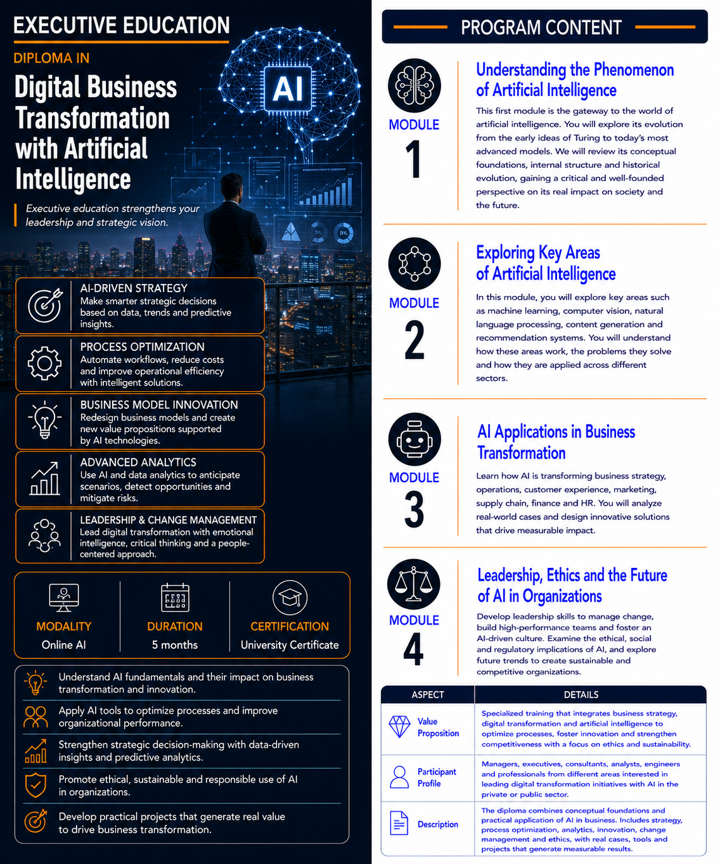
The Diploma in Business Digital Transformation with Artificial Intelligence strengthens executives’ competencies to lead digital transformation in an environment where technology is redefining how organizations compete and create value. It prepares participants to optimize processes, make strategic decisions, and foster innovation through the use of artificial intelligence, integrating leadership, emotional intelligence, and critical thinking into change management.
The program focuses especially on the practical application of AI in business strategy, value-chain optimization, process automation, business-model redesign, and the use of advanced analytics to anticipate scenarios. It incorporates an ethical and sustainable vision of transformation, considering its impact on organizational culture, customer experience, and global competitiveness.
The general objective is to prepare professionals capable of leading digital transformation in business organizations by integrating artificial intelligence solutions that optimize processes, strengthen innovation, and enhance competitiveness.
The program seeks to develop strategic competencies for data-driven decision-making, promote adaptive leadership with emotional intelligence and critical thinking, and strengthen change management in dynamic environments.
It also emphasizes an ethical and sustainable vision that enables organizations to consolidate long-term competitive advantages while ensuring continuous and responsible institutional development.
The program is intended for company professionals who want to strengthen their competencies to participate actively in digital transformation processes through the application of artificial intelligence to process optimization and organizational value creation.
It is also aimed at managers and middle managers from different sectors who need to lead digital transformation strategies with an emphasis on AI, promoting innovation, operational efficiency, and sustainable competitiveness. The program is especially relevant for consultants and business advisers interested in specializing in advanced AI-based digital transformation solutions.
It also welcomes engineers, developers, and data analysts who aspire to leadership roles in technology projects, as well as public- and private-sector professionals committed to organizational innovation, including specialists in IT, marketing, sales, customer service, operations, and product and service development.
This module introduces the universe of artificial intelligence, from the earliest ideas of Turing to today's most advanced models. It reviews AI's conceptual foundations, internal structure, and historical evolution so participants can understand it as a technical and cultural force shaping society and develop a critical, well-grounded view of its present and future role.
This module moves from general understanding to concrete applications, examining machine learning, computer vision, natural language processing, content generation, recommendation systems, and other key areas. Participants learn how these fields work, what problems they solve, and how to identify realistic and ethical use cases.
This module takes knowledge into practice by exploring how AI is integrated into education, healthcare, industry, security, law, culture, and other fields. Through case studies and implementation examples, participants examine the challenges of moving AI from theory into real environments with a critical, strategic, and socially responsible perspective.
This module examines the relationship between artificial intelligence, the digital economy, and business strategy, showing how AI is redefining business models, productivity, and competitiveness in global markets. Participants develop competencies to analyze the economic impact of AI, identify innovation opportunities, and design digital strategies that integrate automation, advanced analytics, and data-driven decision-making. The module connects technological, economic, and strategic dimensions to prepare leaders capable of driving sustainable, agile, and future-oriented businesses in highly disruptive environments.
This module focuses on how to implement digital transformation within organizations, using artificial intelligence as a driver of change and continuous improvement. Participants learn to integrate AI solutions into key work processes such as talent management, automation of critical tasks, creation of intelligent work environments, and data-driven decision-making. Through practical cases and simulations, they explore tools and methodologies for redesigning organizational workflows, strengthening digital culture, improving operational efficiency, and building more agile, resilient, and competitive organizations.
Complete the form and one of our academic advisors will contact you to provide information about the program, costs, start dates, and modality.