
Certification
University
University
3 months
Online Virtual Campus
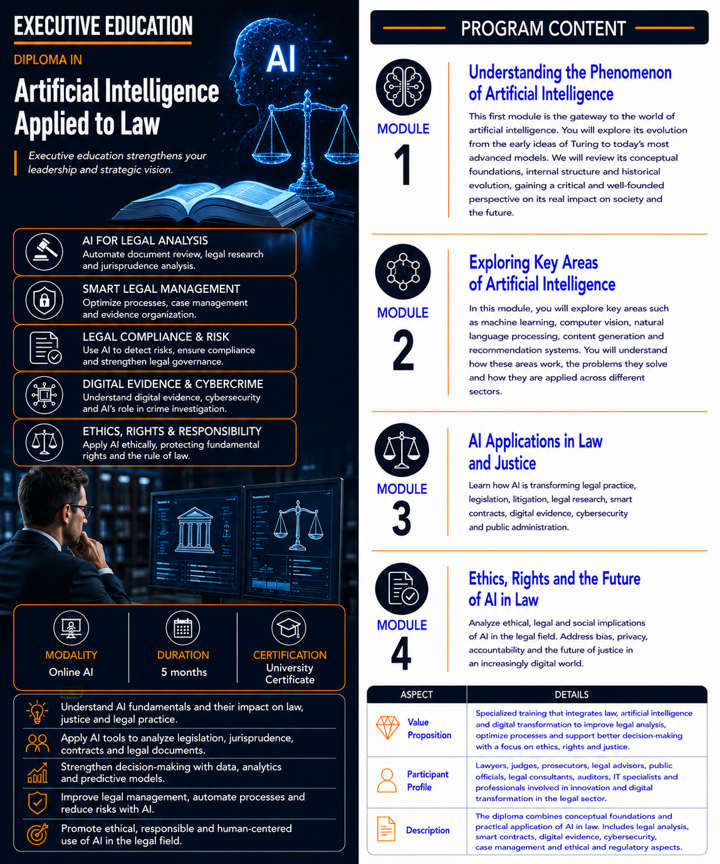
The Diploma in Artificial Intelligence Applied to Law is designed to prepare legal professionals to understand, analyze, and apply intelligent technologies in legislation, the administration of justice, and public and private management. Through a theoretical-practical approach, the program integrates technical foundations, ethical reflection, and the strategic use of digital tools, preparing participants to address the challenges arising from the technological transformation of Law.
The curriculum ranges from the foundations of artificial intelligence and its regulatory framework to applications in cybercrime, digital evidence, smart contracts, and electronic judicial case files.
The general objective of the Diploma in Artificial Intelligence Applied to Law is to prepare professionals to understand, analyze, and critically and responsibly integrate artificial intelligence technologies into legal practice and the administration of justice. The program seeks to strengthen participants’ ability to interpret the functioning, scope, and limitations of AI in complex legal contexts.
It also aims to develop competencies to apply intelligent tools in regulatory, judicial, administrative, and institutional management processes. The program promotes a strategic vision that connects Law, technology, and ethics.
The diploma emphasizes the protection of fundamental rights, transparency, and due process. It also promotes the use of AI to support decision-making and improve judicial efficiency, all oriented toward strengthening the Rule of Law in contexts of digital transformation.
The Diploma in Artificial Intelligence Applied to Law is intended for legal professionals who seek to understand and strategically apply artificial intelligence technologies in their professional practice.
It is aimed at lawyers, judges, prosecutors, public defenders, judicial officials, and legal advisers involved in regulatory, jurisdictional, or administrative processes. It is also designed for public managers, consultants, experts, and auditors involved in the modernization of the justice system, as well as technical and innovation professionals who collaborate with legal teams on digital transformation projects.
No previous training in programming or advanced computing is required. The program is designed for those who want to strengthen a critical, ethical, and applied vision of AI in legal contexts. Its interdisciplinary approach brings together diverse professional profiles with a common interest in contemporary justice.
This module introduces the universe of artificial intelligence, from the earliest ideas of Turing to today's most advanced models. It reviews AI's conceptual foundations, internal structure, and historical evolution so participants can understand it as a technical and cultural force shaping society and develop a critical, well-grounded view of its present and future role.
This module moves from general understanding to concrete applications, examining machine learning, computer vision, natural language processing, content generation, recommendation systems, and other key areas. Participants learn how these fields work, what problems they solve, and how to identify realistic and ethical use cases.
This module takes knowledge into practice by exploring how AI is integrated into education, healthcare, industry, security, law, culture, and other fields. Through case studies and implementation examples, participants examine the challenges of moving AI from theory into real environments with a critical, strategic, and socially responsible perspective.
This module develops competencies to apply artificial intelligence to institutional planning and process management within the legal field. Participants analyze continuous improvement methodologies, performance indicators, decision traceability, and the application of ISO standards in the administration of justice. The approach combines AI tools with data governance and quality-control models, enabling the design of strategies that optimize time, resources, and transparency in judicial and administrative management.
This module deepens the use of artificial intelligence for the efficient administration of case files, document digitization, and workflow automation. It addresses international quality standards and their integration with interoperable legal systems, ensuring security, traceability, and access to information. Participants develop skills to design and implement intelligent case-management systems aligned with principles of efficiency, institutional responsibility, and continuous improvement.
Complete the form and one of our academic advisors will contact you to provide information about the program, costs, start dates, and modality.