
Certification
University
EXECUTIVE EDUCATION
University
3 months
Online Virtual Campus
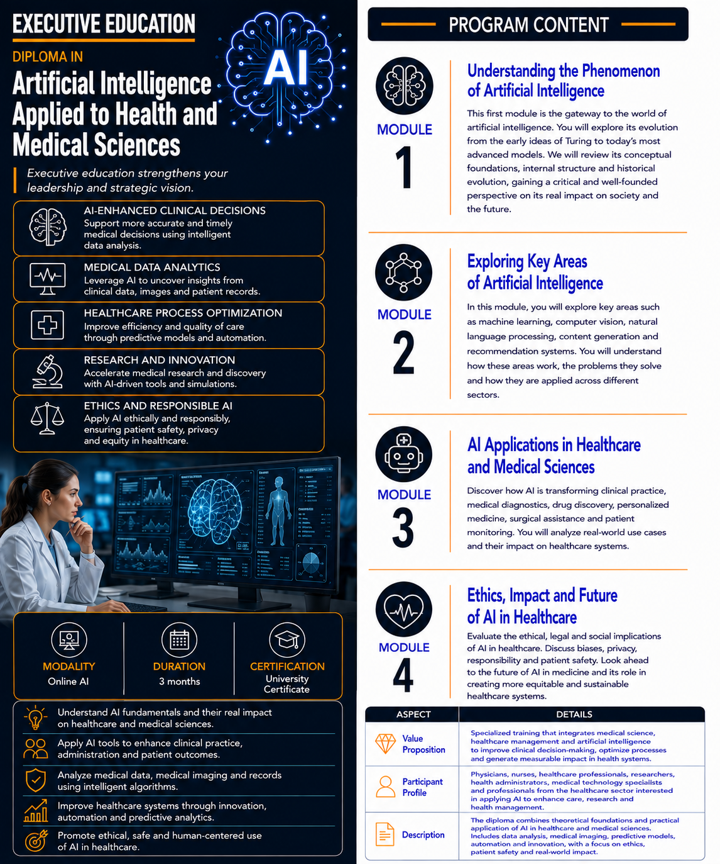
The Diploma in Artificial Intelligence Applied to Health and Medical Sciences is designed to prepare professionals to understand, evaluate, and implement artificial intelligence solutions in clinical, care, research, and healthcare management contexts, with a rigorous, ethical, and human-centered approach.
The program approaches artificial intelligence not as an isolated technology, but as a strategic support tool for medical decision-making, clinical data analysis, optimization of care processes, and strengthening of health systems. Throughout the diploma, participants will understand how AI models work internally, how they process medical information, and what their real capabilities and limitations are in clinical environments.
The program prepares professionals in health and medical sciences to understand and apply artificial intelligence in clinical, care, and healthcare management contexts, developing competencies to evaluate its functioning, scope, and limitations in medical practice.
It seeks to strengthen decision-making supported by data and scientific evidence, optimize clinical and organizational processes, and integrate AI as a tool that supports professional judgment.
The program also promotes analysis of ethical risks, bias, and responsibilities associated with the use of these technologies, encouraging safe, critical, and human-centered adoption aimed at continuous improvement in quality of care and stronger health systems.
The diploma is designed for health and medical sciences professionals working in clinical, care, academic, research, and healthcare management settings who seek to understand and incorporate artificial intelligence into their professional practice.
It is aimed at physicians, dentists, nurses, public health professionals, researchers, executives, and managers of healthcare institutions, as well as technical and administrative teams in the health sector interested in applying AI strategically and responsibly.
No previous programming knowledge is required. The program is designed for professionals who want to strengthen their analytical capacity, decision-making, and leadership in the context of digital transformation in healthcare.
This module introduces the universe of artificial intelligence, from the earliest ideas of Turing to today's most advanced models. It reviews AI's conceptual foundations, internal structure, and historical evolution so participants can understand it as a technical and cultural force shaping society and develop a critical, well-grounded view of its present and future role.
This module moves from general understanding to concrete applications, examining machine learning, computer vision, natural language processing, content generation, recommendation systems, and other key areas. Participants learn how these fields work, what problems they solve, and how to identify realistic and ethical use cases.
This module takes knowledge into practice by exploring how AI is integrated into education, healthcare, industry, security, law, culture, and other fields. Through case studies and implementation examples, participants examine the challenges of moving AI from theory into real environments with a critical, strategic, and socially responsible perspective.
This module explores advanced applications of artificial intelligence for improving clinical diagnosis and designing personalized therapeutic interventions, integrating digital health technologies into the care process. Participants examine predictive models capable of identifying early clinical patterns, supporting decision-making, and reducing variability in medical image analysis. The module also addresses algorithms used in precision medicine, molecular characterization, risk analysis, and dynamic patient monitoring through digital platforms. Emphasis is placed on the ethical and safe use of these tools, developing competencies to interpret results, validate models, and apply digital solutions that improve clinical effectiveness and safety.
This module addresses the strategic use of artificial intelligence as a driver of transformation in public health and hospital administration, with emphasis on digital solutions that optimize management processes and epidemiological surveillance. Participants analyze population prediction models, automated analysis of large healthcare databases, and AI-based early warning systems to support public policy decisions. The module also examines intelligent management tools to improve resource allocation, hospital flow management, and operational efficiency through integrated digital platforms. It prepares professionals to lead digital health projects, assess their impact, and promote evidence-based healthcare management oriented toward equity.
Complete the form and one of our academic advisors will contact you to provide information about the program, costs, start dates, and modality.