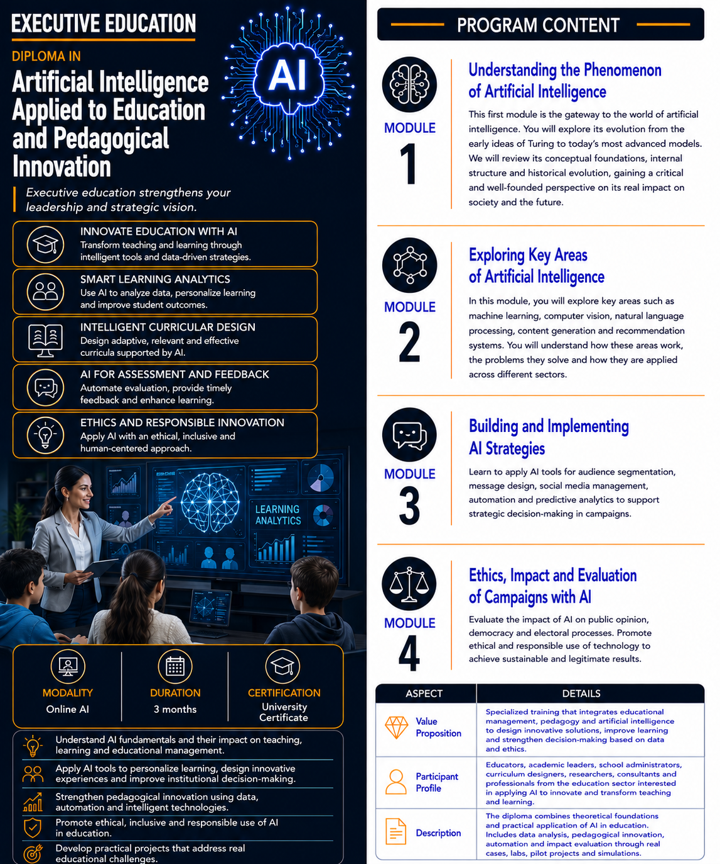

Certification
University
EXECUTIVE EDUCATION
University
3 months
Online Virtual Campus
The Diploma in Artificial Intelligence Applied to Education and Pedagogical Innovation responds to the changes that technology is generating across educational systems. Artificial intelligence has become a strategic tool for optimizing management, analyzing data, and transforming teaching, learning, and assessment. In this context, the program prepares professionals to understand and apply AI through a critical, ethical, and innovative approach.
The program is grounded in a theoretical and practical framework that combines recent advances in artificial intelligence with pedagogical and curricular applications. Participants develop competencies to make informed decisions and design innovative educational strategies. Ethics and social responsibility are emphasized as essential principles to ensure that technology is used to support learning and equity.
The program seeks to prepare professionals with theoretical and practical foundations to critically analyze the scope and limitations of artificial intelligence in education. Participants will develop competencies to integrate these tools ethically and responsibly into institutional management, curriculum planning, and pedagogical practices.
It promotes a strategic vision focused on innovation, strengthening the ability to design solutions that improve teaching and learning. The program also develops research and evaluation skills supported by AI, optimizing decision-making and the use of data.
The objective is to foster a socially responsible approach that ensures respectful and equitable applications of artificial intelligence across educational environments.
The diploma is designed for professionals in education and related fields who seek to understand and apply artificial intelligence in institutional management and pedagogical processes. It is aimed at educators, supervisors, school leaders, and those responsible for public and private educational institutions who are interested in incorporating AI tools into teaching practices and academic administration.
It is also intended for higher-education specialists involved in academic management, teaching, research, quality assurance, and evaluation who wish to innovate and strengthen their competencies in this field.
The program also addresses teachers, psychologists, educational psychologists, and other professionals involved in educational development who recognize the transformative impact of artificial intelligence on learning and student development.
This module introduces the universe of artificial intelligence, from the earliest ideas of Turing to today's most advanced models. It reviews AI's conceptual foundations, internal structure, and historical evolution so participants can understand it as a technical and cultural force shaping society and develop a critical, well-grounded view of its present and future role.
This module moves from general understanding to concrete applications, examining machine learning, computer vision, natural language processing, content generation, recommendation systems, and other key areas. Participants learn how these fields work, what problems they solve, and how to identify realistic and ethical use cases.
This module takes knowledge into practice by exploring how AI is integrated into education, healthcare, industry, security, law, culture, and other fields. Through case studies and implementation examples, participants examine the challenges of moving AI from theory into real environments with a critical, strategic, and socially responsible perspective.
This module addresses the role of artificial intelligence in academic organization and curriculum design, highlighting its potential to optimize educational processes. Participants will learn to apply AI tools to content planning, the personalization of learning pathways, and the management of pedagogical resources. Case studies will show how AI can support curricular innovation and continuous improvement. Participants will also develop criteria to evaluate the relevance and limits of AI applications in different educational contexts, combining theory and practice in the strategic design of evidence- and data-based curricula.
This module explores how artificial intelligence can transform teaching through active, adaptive, and student-centered methodologies. Applications that support personalized learning, immediate feedback, and the design of innovative educational experiences are analyzed. Participants will learn to integrate AI tools into learning activities, formative assessment, and pedagogical support processes. The module also addresses the importance of ethical and responsible use of these technologies to preserve the human dimension of education, fostering teacher creativity and the ability to design proposals that strengthen educational quality and meaningful learning.
Complete the form and one of our academic advisors will contact you to provide information about the program, costs, start dates, and modality.